
CAREERS SUPPORT
Our Careers Guide Hub can be found HERE
At Etone College we have a dedicated sixth form team who are there to support you with your next steps. Below outlines the support you get with UCAS and applying to university:
- 1:1 tutor support to read through and offer guidance on your personal statement
- 1:1 meeting with our Careers Advisor and the Head of Sixth Form
- Presentations on the application process and support through all steps
- University trips
- Sharing of Open Days with parents through awareness and letters
- Sharing of wider participation programmes pupils can attend to strengthen university applications
- Open on results day to support with clearing
- Support on how to apply for university admissions tests
- Information on Student Finance England and how you can afford to go to university
- Parent engagement sessions to foster greater understanding and collaboration about the UCAS process
- Additional guidance and tailored support for those applying to top universities (Oxbridge) and highly competitive courses
- Alumni talks about university and courses (including Oxford University Alumni)
Securing Your Place at a Top University
Careers Overview Padlet
Interview Guidance
Apprenticeships
An apprenticeship is a paid job that combines practical work with structured study. Apprentices spend most of their time gaining hands-on experience in a real workplace, while also working towards a recognised qualification. Alongside earning a salary and being part of a professional team, apprentices receive regular, dedicated time each week for learning.
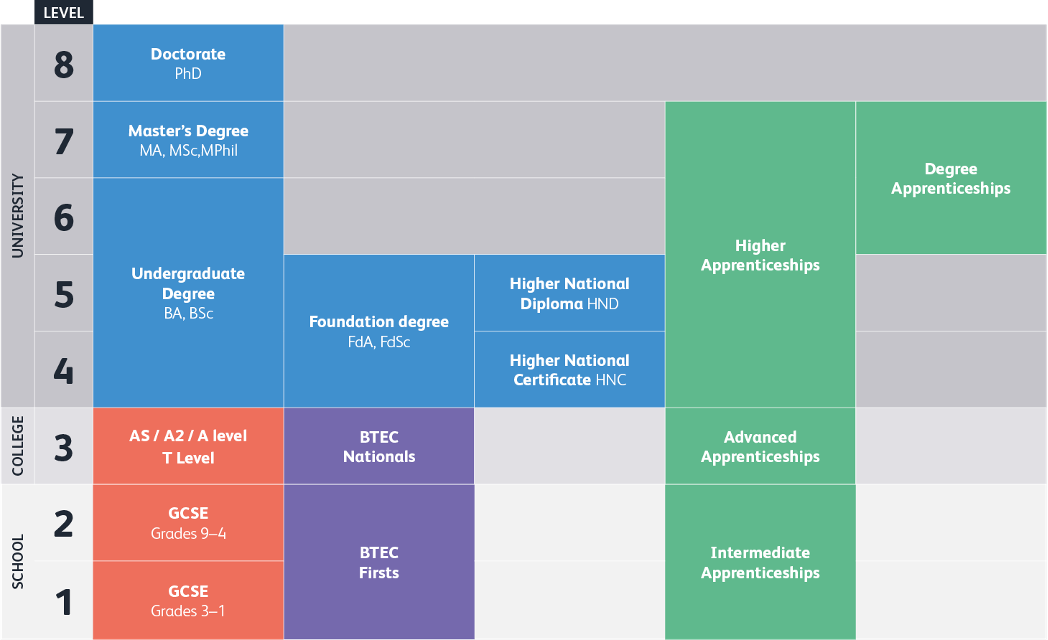
Apprenticeships are available at a range of levels, from programmes equivalent to GCSEs through to those comparable with a master’s degree. The level and type of apprenticeship available depend on factors such as your location in the UK, your existing qualifications, and the entry requirements set by employers and training providers.
This makes apprenticeships a flexible and accessible route into employment, whether you are starting your career or looking to develop new skills within a specific industry.
Have a look at how apprenticeships compare to other qualifications:
More Information - https://www.gov.uk/apply-apprenticeship
Degree Apprenticeships
A degree apprenticeship allows students to earn a full undergraduate or master’s degree while working in a paid role. Depending on the level of the course, degree apprenticeships typically take between three and six years to complete.
Students spend the majority of their time in the workplace, gaining valuable hands-on experience, while studying part-time with a university or training provider. This may involve attending university one or two days per week, or studying in block sessions throughout the year. Overall, around 80% of time is spent working and 20% studying.
Degree apprenticeships are available across the UK, although they operate slightly differently in each nation:
- England and Wales both offer degree apprenticeships, with the widest range of opportunities currently available in England.
- Scotland offers similar programmes known as Graduate Apprenticeships.
- Northern Ireland provides Higher Level Apprenticeships (HLAs), which can lead to qualifications up to Level 7 (equivalent to a master’s degree). However, most HLAs are offered at Level 5, which is equivalent to a foundation degree.
https://www.ucas.com/apprenticeships/degree-apprenticeships